
Invest & Expand
in India
Entry Routes
How Can a Foreign Company Enter India?
India offers multiple legal entry structures. We help you choose the right one based on your sector, FDI policy, and business goals.
Private Limited Company (Subsidiary)
The most common entry route for foreign companies. Offers limited liability, easy FDI compliance, and full ownership (100% FDI allowed in most sectors).
- 100% foreign ownership allowed
- ROC registered entity
- Easy to raise equity
- Separate legal entity
Liaison / Representative Office
A Liaison Office acts as a communication and representative channel for the foreign parent. It may undertake market research, promotion and liaison activities but cannot conduct revenue-generating business in India.
- Cannot undertake commercial or revenue-generating operations
- Facilitates communication and liaison activities
- Conducts market research and business promotion
- Acts as an extension of the foreign parent company
Branch Office
A foreign company can set up a Branch Office in India to carry on manufacturing, trading or services allowed under FEMA regulations.
- Can remit profits abroad
- Suitable for specific sectors
- RBI / FEMA approval
- Parent company liable
Limited Liability Partnership (LLP)
Suitable for professional services and low-capital ventures. FDI allowed in LLPs under automatic route in sectors where 100% FDI is permitted.
- Flexible profit sharing
- Partner liability limited
- FDI under automatic route
- Lower compliance than Pvt Ltd
Our Services
End-to-End Support for Foreign
Investors in India
India Entry Strategy
We assess the best entry structure for your business — subsidiary, LLP, liaison or branch — based on sector, FDI policy, and operations.
Company Incorporation
Complete assistance with MCA registration, DSC, DIN, MOA/AOA drafting, PAN/TAN, and bank account opening for foreign-invested companies.
FDI Compliance & FEMA
Expert guidance on FDI reporting (FC-GPR, FC-TRS), FEMA compliance, RBI reporting, and annual filings under FCRA/FEMA.
Tax Registration & Compliance
GST registration, income tax PAN, advance tax planning, transfer pricing, and annual compliance calendar management.
Ongoing Accounting & CFO
Monthly bookkeeping, MIS reports, payroll, and Virtual CFO advisory for foreign-invested entities in India.
HR & Employment Support
Employment contracts, PF/ESI registration, labour law compliance, and expatriate payroll support.
Our Process
Your India Entry — Step by Step
01
Initial Consultation
Understand your business, sector, and goals. Recommend the best entry structure.
02
Entity Incorporation
Handle all MCA, RBI, and FEMA filings to legally set up your Indian entity.
03
Tax & Compliance Setup
GST, PAN, bank accounts, FDI reporting, and all regulatory registrations.
04
Ongoing CA Support
Monthly accounting, MIS, payroll, and compliance management through our CA team.
Global Investment into India
The World Invests in India
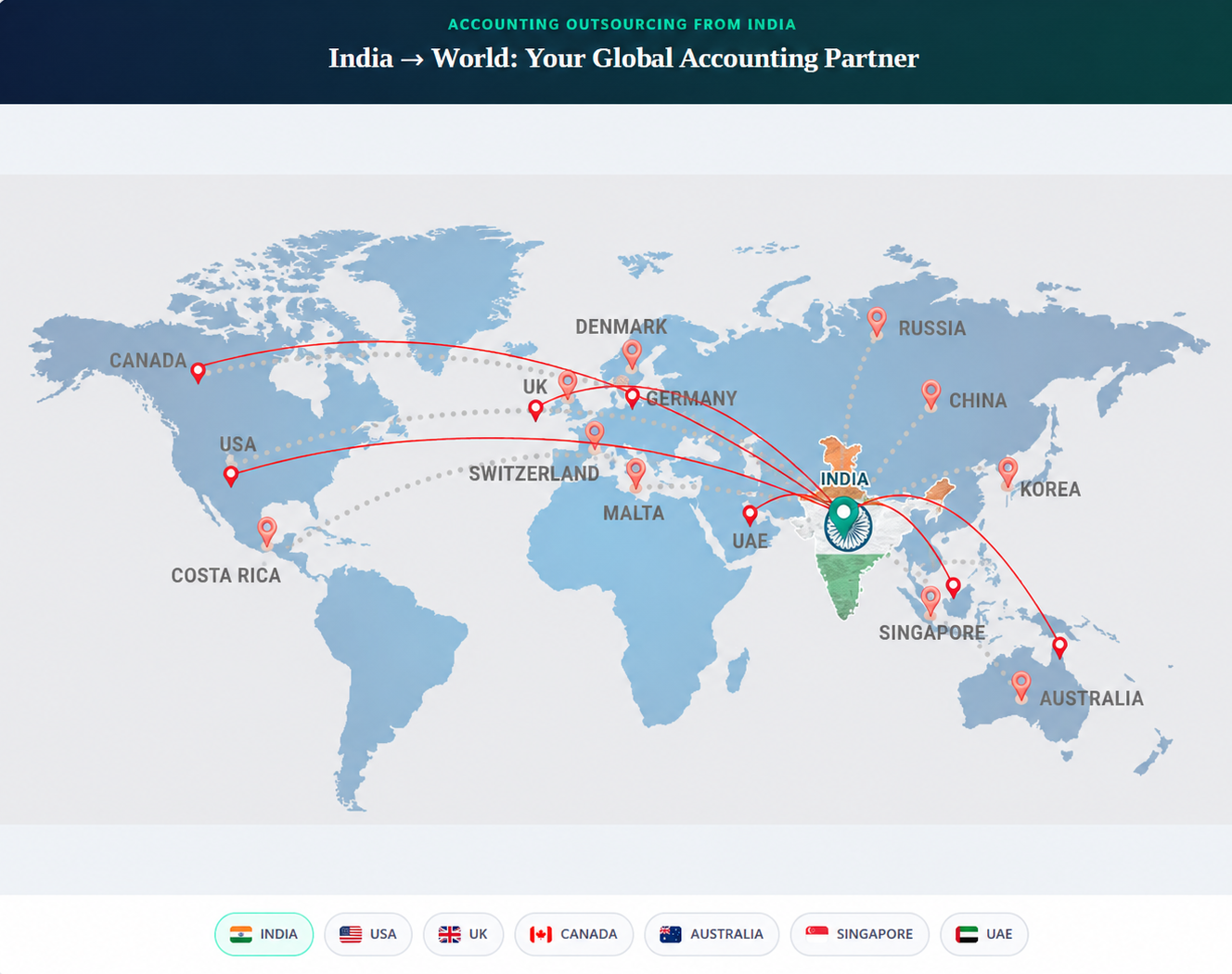
From our base in Delhi, India, True Ledger Partners delivers seamless accounting and finance services to clients across 7 major global markets.
Frequently Asked Questions
Company Registration & Foreign Investment in India
The registration timeline depends on the type of business entity and document readiness. In most cases, a Private Limited Company can be incorporated within 7–15 working days. If additional government approvals or foreign investment clearances are required, the process may take longer. Our team manages the complete incorporation process to ensure timely and hassle-free registration.
Yes. Under India's Foreign Direct Investment (FDI) Policy, foreign investors can own up to 100% equity in many sectors through the Automatic Route, which does not require prior government approval. Certain industries, however, have sector-specific restrictions or require approval from the Government of India. We help you determine the most suitable investment route based on your business activity.
FEMA (Foreign Exchange Management Act, 1999) is the primary law governing foreign investments, cross-border transactions, and foreign exchange in India. Every foreign-owned company must comply with FEMA regulations regarding capital investment, reporting to the Reserve Bank of India (RBI), share allotments, and other financial transactions. Our experts ensure your business remains fully compliant with all FEMA requirements.
No. India currently does not prescribe a minimum paid-up capital requirement for incorporating a Private Limited Company. You can start your business with a capital structure that suits your operational needs. However, the investment amount should be adequate to support your planned business activities and future growth.
Generally, foreign directors and shareholders need to provide:
Passport copy
Address proof
Recent passport-size photograph
Business incorporation documents (for corporate shareholders)
Board Resolution (if applicable)
Additional documentation may be required depending on the country of incorporation and business structure.
The ideal business structure depends on your objectives. A Private Limited Company is the most popular option for long-term operations and attracting investment. A Branch Office is suitable for companies looking to conduct approved business activities in India, while a Liaison Office is designed for market research and representation without commercial operations. We help you choose the most appropriate structure based on your expansion plans.